
Open Source
TurboDiffusion: Accelerating Video Diffusion Models by 100-200 Times
View PaperTo improve the inference speed of diffusion models, especially video generation models, Tsinghua University's TSAIL Lab and Shengshu Technology jointly release the diffusion acceleration framework TurboDiffusion, which incorporates multiple acceleration techniques and can accelerate video generation by 100-200 times.
Four Core Technologies Working Together to Accelerate Video Generation
TurboDiffusion mainly contains four techniques to accelerate diffusion models:
- First, TurboDiffusion uses SageAttention for low-bit quantized attention acceleration, specifically the SageAttention2++ version.
- Second, TurboDiffusion employs Sparse-Linear Attention (SLA) to speed up sparse attention. Since sparse computation is orthogonal to low-bit Tensor Core acceleration, SLA can be built on top of SageAttention to achieve additional multi-fold speedups during inference.
- Third, TurboDiffusion leverages rCM for step distillation acceleration, which is currently a state-of-the-art method in this area.
- Finally, TurboDiffusion applies W8A8 quantization to accelerate Linear layers. It uses the INT8 data type with block-wise quantization, with a block size of 128×128.
These four core technologies were independently developed by Tsinghua University TSAIL team and Shengshu Technology. They carry milestone significance and far-reaching impact for both breakthroughs in AI multimodal foundation models and their industrial-scale deployment. In particular, SageAttention is the first method to enable low-bit attention acceleration and has already been deployed at scale across the industry.
For example, SageAttention has been successfully integrated into NVIDIA's inference engine TensorRT, and has also been deployed and productionized on major GPU platforms such as Huawei Ascend and Moore Threads S6000. In addition, leading global and domestic technology companies and teams, including Tencent Hunyuan, ByteDance Doubao, Alibaba Tora, Shengshu Vidu, Zhipu Qingying, Baidu PaddlePaddle, Kunlun Wanwei, Google Veo3, SenseTime, and vLLM, have adopted this technology in their core products, generating substantial economic value.
Up to 200× Speedup on a Single GPU: From Minutes to Seconds
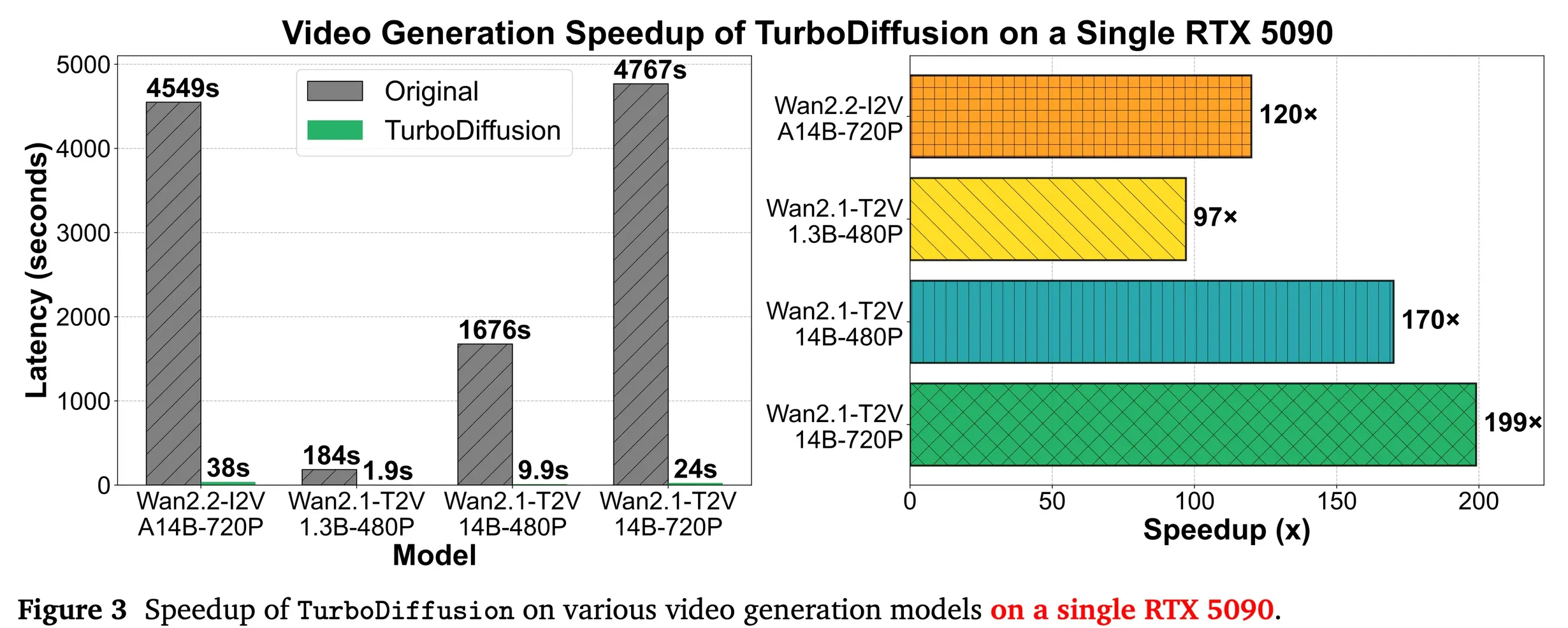
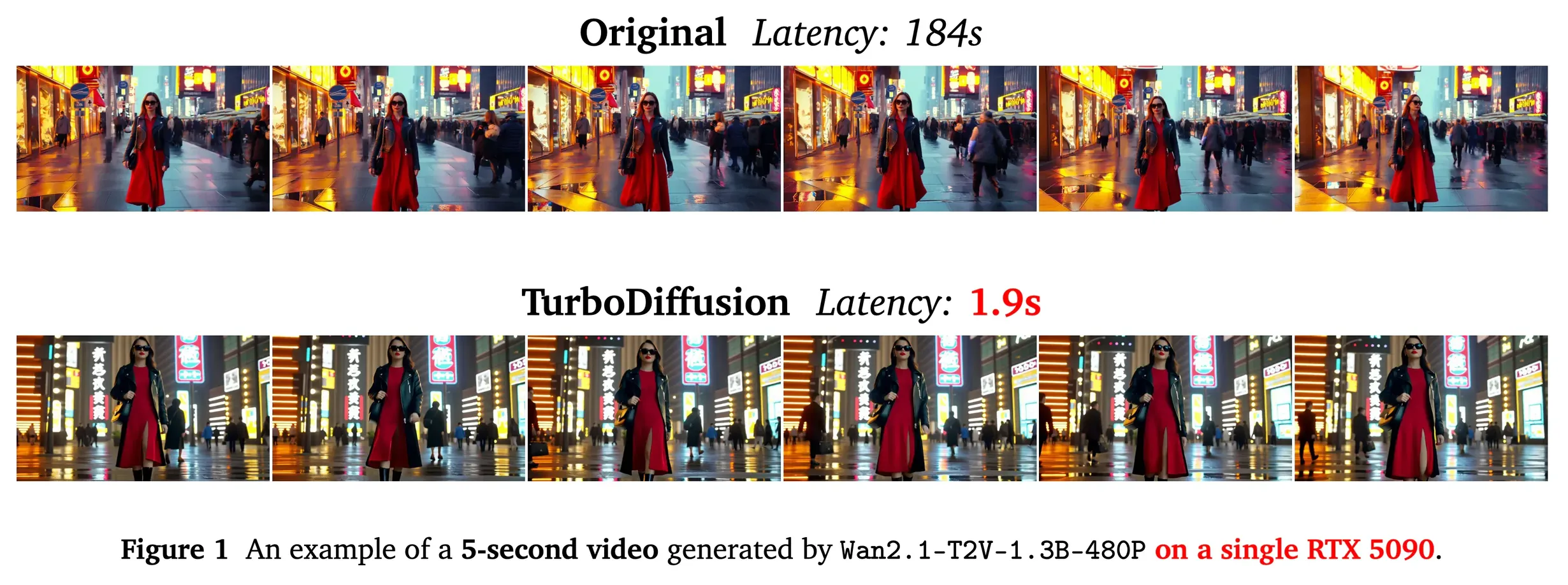
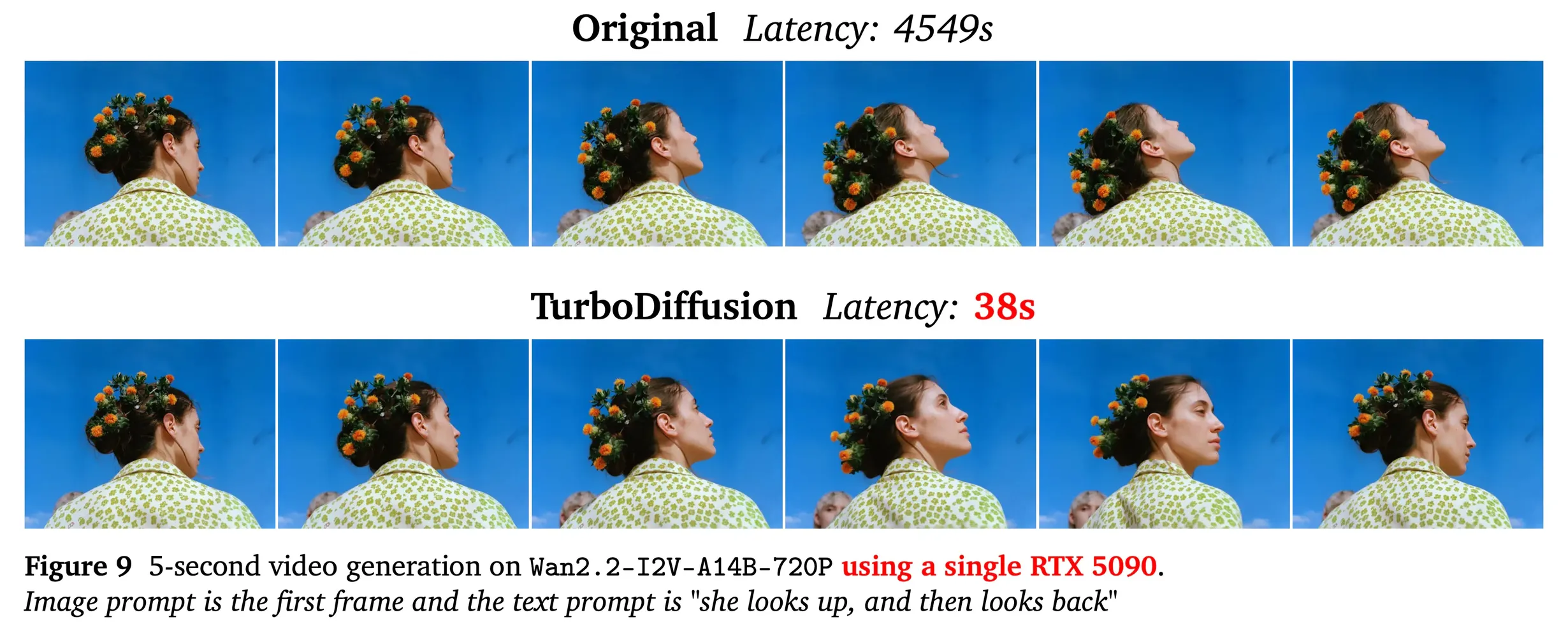
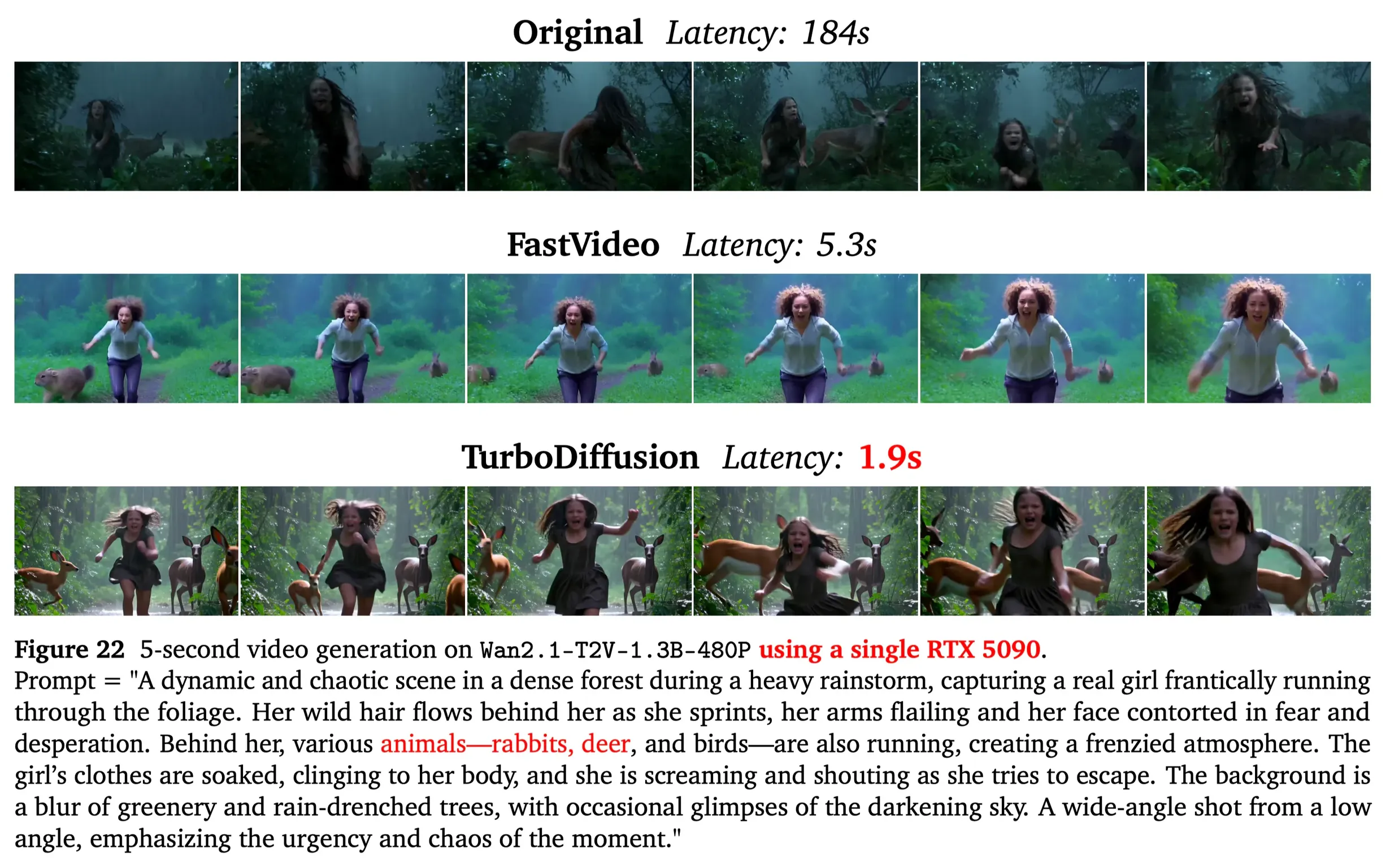
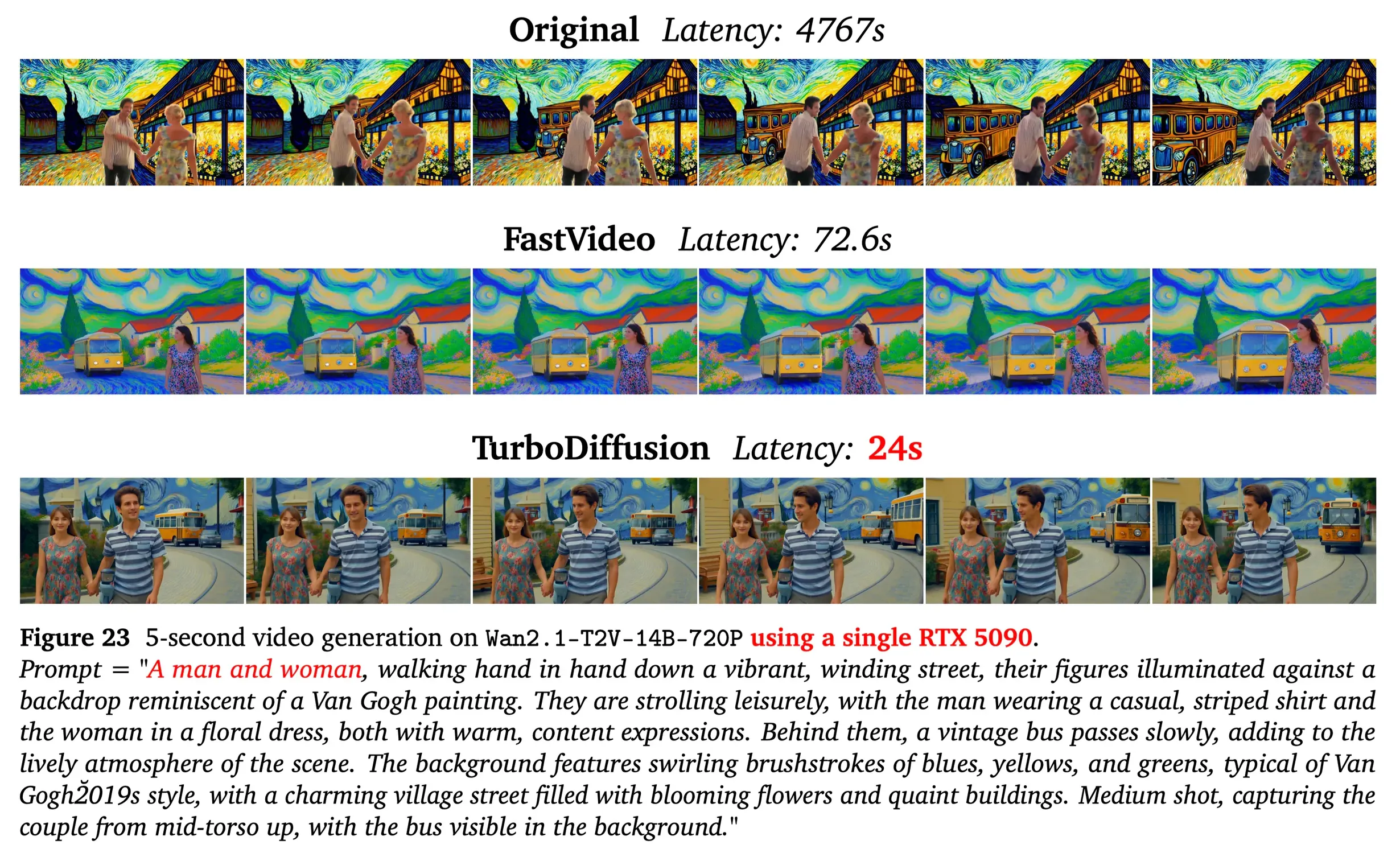
For the open-sourced T2V and I2V models, TurboDiffusion could achieve 100× and 200× end-to-end acceleration in video generation on a single RTX 5090, respectively. For more details, please refer to TurboDiffusion.
Industrial Value and Application Prospects
Applying the techniques in TurboDiffusion to the Vidu model also delivers extremely high inference acceleration without sacrificing video generation quality. For example, when generating an 8-second high-quality video at 1080P resolution, TurboDiffusion can reduce the end-to-end generation latency from 900 seconds to 8 seconds, compared with video generation without inference-acceleration optimizations.
Video Comparison 1
Original — Generation Time: 450s
Using TurboDiffusion — Generation Time: 4s
Video Comparison 2
Original — Generation Time: 900s
Using TurboDiffusion — Generation Time: 8s
Toward the Real-Time Generation Era of AI Creation
It is widely believed that the next era of AI video will be defined by faster generation, lower computational costs, and a better user experience, while maintaining or even improving generation quality. This will make AI video more affordable and accessible for enterprises, and smoother and faster for creators to use.
The release of TurboDiffusion marks a key step in this direction. Moving forward, Shengshu Technology will continue to advance generative AI across efficiency, cost, and user experience, lowering the barrier to adoption and enabling AI video to be applied across broader real-world scenarios, accelerating both industry development and technology adoption.